
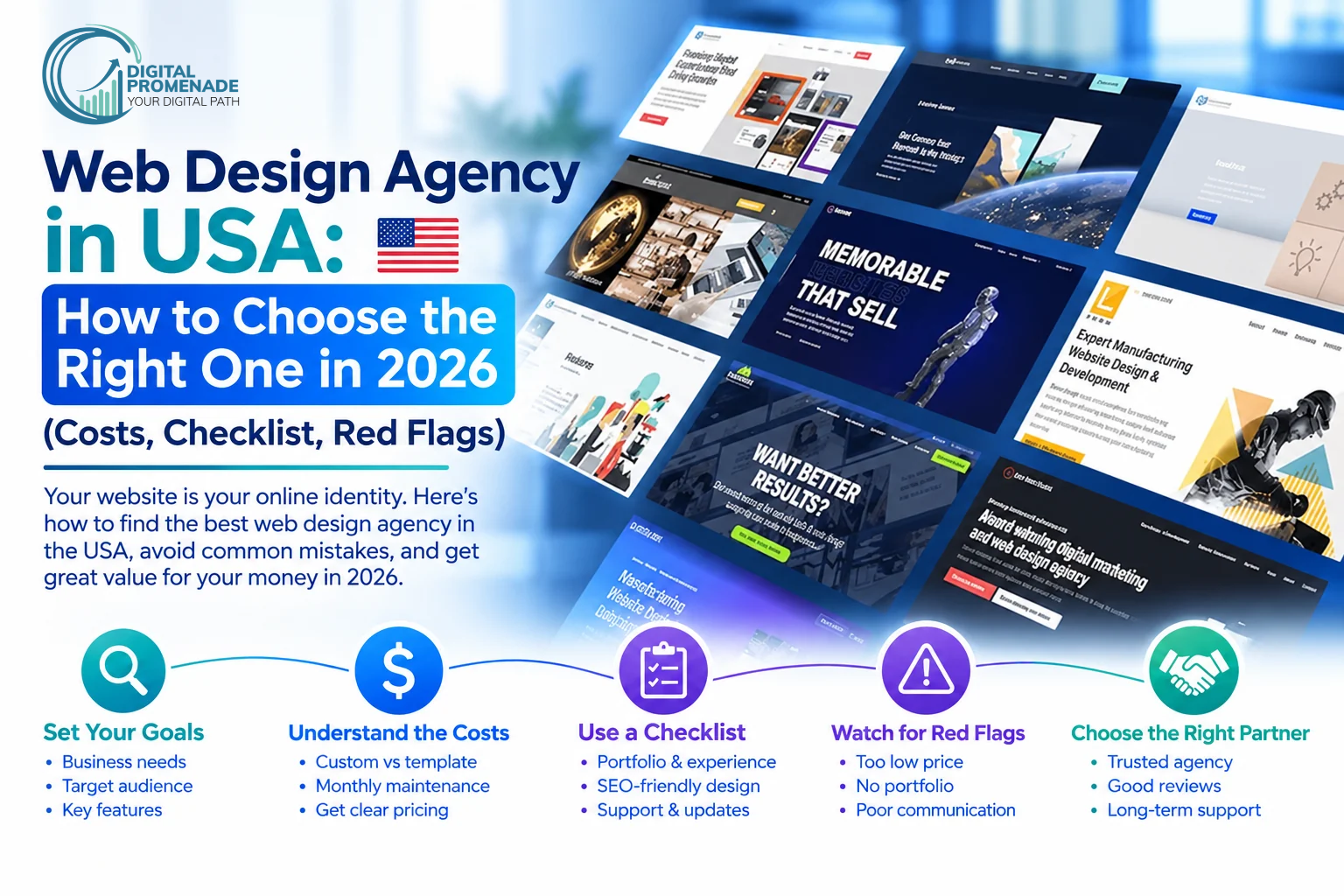
Web Design Agency in USA: How to Choose the Right One in 2026 (Costs, Checklist, Red Flags)
Choose a web design agency by checking four things in order: live client work with measurable results, a written itemized quote, a contract that gives you ownership of the code, and a clear plan for SEO and speed. One 2026 agency guide puts simple sites at $5,000 to $25,000 and complex or custom sites at $25,000 to $150,000 or more. Walk away from vague pricing, rushed decisions, and guaranteed rankings.
This guide gives you the framework we would use if we were hiring. It covers how to compare agencies, what a project costs, which questions to ask, and which warning signs should end a conversation. We wrote it for US business owners, including those weighing a team outside the United States.
Most pages that rank for this topic cover one piece: a red-flag list, a cost range, or a question list. We put all three in one place and add a scorecard, a contract checklist, and a section on hiring across time zones.
Web Design Agency in USA at a Glance
| Question | Short answer |
| Cost of a simple site | $5,000 to $25,000, per one 2026 agency guide |
| Cost of a complex or custom site | $25,000 to $150,000 or more, per the same guide |
| Most common agency type | Full-service. About 56% of agencies identify that way, per the 2026 Web Agency Industry Report cited by Moburst |
| Best first filter | Live client sites with measurable results |
| Must-have contract clause | You own the design files, code, and domain |
| Biggest red flags | Vague pricing, pressure to sign fast, guaranteed rankings |
| Shortlist size | Three to five agencies |
Quick summary: Expect $5,000 to $25,000 for a simple site and $25,000 to $150,000 or more for a custom one. Shortlist three to five agencies, check live client work, and insist on owning your code.
What Does a Web Design Agency Actually Do?
A web design agency plans, designs, builds, and launches websites for businesses. Many also handle SEO, content, and advertising, so the line between a web design and development agency and a full marketing partner has blurred.
What Work Is Included in a Website Project?
A complete project usually includes discovery, wireframes, visual design, front-end and back-end development, content management setup, testing, and launch. Ask which of these the quote covers. Some agencies price design only and bill development separately.
Which Types of Agency Can You Hire?
| Type | What they do | Best for | Watch for |
| Design-only studio | Brand, layout, and visual design | Companies with their own developers | Handoff gaps between design and code |
| Full-service agency | Design, development, SEO, content, and ads | Businesses that want one team | Quality spread thin across services |
| Development-led firm | Custom builds, integrations, and web apps | Complex sites and platforms | Plain design and weak marketing input |
Web development firms tend to sit in the third row, and a website development and digital marketing company sits in the second. Digital marketing website design, where the site is built around lead generation, usually comes from the second type.
Quick summary: A web design agency handles planning, design, development, testing, and launch, and many add SEO and marketing. Pick the agency type that matches your project: design-only, full-service, or development-led.
How Do You Choose the Right Web Design Agency in the USA?
Use a six-step process and score every agency the same way. The steps below take about one to two weeks if you move steadily.
Step 1: Define Your Goals and Budget
Write a one-page brief before you contact anyone. Include these items:
- The main goal: leads, online sales, bookings, or credibility
- Pages and features you need, plus integrations such as a CRM or payment system
- Your deadline and the one person who approves decisions
- A budget range you can share
Agencies that receive a clear brief give better quotes, and you can compare them fairly.
Step 2: Build a Shortlist of Three to Five
Start with referrals, then review platforms and search. One guide suggests searching for the services an agency sells and checking that the agency’s own site appears in the results. An agency that cannot rank its own site deserves a harder look.
Step 3: Open Live Client Sites, Not Decks
Visit three client sites on your phone. Test load speed, forms, and navigation. Utsubo’s guide notes two patterns to watch: sites that all look identical suggest a template approach, and missing mobile examples suggest mobile is an afterthought.
Step 4: Verify Results in Case Studies
Ask for numbers with dates: conversion rate, leads, or load time before and after the project. Then ask to speak with one past client. A case study with no metrics proves little.
Step 5: Score Proposals Side by Side
We use the weighted scorecard below. The weights are our own judgment, so adjust them to your priorities.
| Criterion | Weight | What earns full marks |
| Proof of results | 25 | Live sites, dated metrics, a reachable reference |
| Process and discovery | 20 | A structured discovery phase and milestone plan |
| Contract and ownership | 15 | You own the code, files, and domain on final payment |
| Technical and SEO readiness | 15 | Speed targets, clean structure, redirect plan |
| Price transparency | 15 | An itemized quote with no unexplained lines |
| Communication | 10 | A named lead, set meeting times, written updates |
Drop any agency that scores below 60 in total or zero on ownership.
Step 6: Review the Contract Before You Commit
Read the ownership, support, and change-order clauses line by line. The next sections cover what to look for.
Quick summary: Define a brief, shortlist three to five agencies, inspect live sites, verify results with a reference, score proposals on a weighted scorecard, and read the contract before signing.
How Much Does a Web Design Agency Cost in the USA in 2026?
Costs depend on scope, not just page count. One 2026 guide gives $5,000 to $25,000 for simple sites and $25,000 to $150,000 or more for complex or custom projects. Treat those as one agency’s market view, not a standard price list. A web design agency cost quote should always arrive itemized.
What Does Each Project Type Cost?
| Project type | Typical USD range | What drives the price |
| Simple brochure site | $5,000 to $25,000 | Scope agreed in a written quote |
| Digital Promenade projects | $25,000 to $150,000 or more | Page count, custom design, content help |
| Complex or custom site | $22,000 to $160,000 or more | Integrations, custom features, user accounts |
If you sell online, plan product-page SEO from the start. Our guide to ecommerce SEO techniques shows what the build should support.
Which Pricing Model Fits Your Project?
| Model | Best for | Risk |
| Fixed price | A defined scope and deadline | Change orders if the scope shifts |
| Hourly | Uncertain or exploratory work | Costs grow without a cap |
| Monthly retainer | Ongoing updates, SEO, and support | Paying for unused hours |
What Hidden Costs Should You Budget For?
Ask the agency to price these separately, since pricing should reflect what the package includes, not only the upfront number:
- Hosting, domain, and security certificates
- Ongoing maintenance and software updates
- Content writing, photography, and video
- Third-party tools and integrations
- Post-launch support after the warranty period
Quick summary: Simple sites run about $5,000 to $25,000 and custom builds $25,000 to $150,000 or more, according to one agency guide. Fixed price suits a defined scope, and you should price hosting, maintenance, content, and support separately.
Should You Hire an Agency, a Freelancer, or an In-House Team?
Hire an agency when you need design, development, and marketing under one contract. Hire a freelancer for a small, well-defined job. Build an in-house team only when you will update the site every week.
| Option | Best for | Strength | Risk |
| Agency | Full builds and growth work | Broad skills, one point of accountability | Higher cost, junior staff on the project |
| Freelancer | Small sites and fixes | Lower cost, direct contact | One person is a single point of failure |
| In-house team | Constant updates | Deep product knowledge | Salaries, hiring time, tool costs |
A business that needs a five-page site and no marketing can work well with a strong freelancer. A business that needs a custom booking system, SEO, and ad landing pages will usually save time with an agency.
Quick summary: Choose an agency for broad projects, a freelancer for small defined jobs, and an in-house team only for constant updates. The right choice depends on scope and how often you change the site.
Which Questions Should You Ask a Web Design Agency Before Signing?
Ask ten questions on the first call and put the contract terms in writing. Good agencies answer directly. Evasive answers tell you something too.
What Are the Ten Questions for the First Call?
- Can you share three live client sites similar to mine?
- What results did those sites produce, and over what period?
- Who will work on my project, and who is my main contact?
- What does your discovery phase include?
- Is the quote itemized, and what could change the price?
- Who owns the design files, code, and domain after launch?
- How do you build for speed, mobile, and SEO?
- What support do you provide after launch, and for how long?
- How do you handle change requests?
- Can I speak with a past client?
Which Contract Clauses Matter Most?
| Clause | What to look for | Why it matters |
| Ownership | Rights transfer to you on final payment | Prevents lock-in |
| Code repository | The repository sits in an account you control | One guide warns that an agency-held repository can leave you without the site if their lead leaves |
| Milestone payments | Payments tied to delivered work | Keeps incentives aligned |
| Change orders | A written process and rate for scope changes | Avoids surprise invoices |
| Post-launch support | A defined warranty period and response times | Covers early bugs |
| Termination | Clear exit terms and file handover | Protects you if the relationship fails |
The same clauses matter when you hire for marketing work. Our checklist before you sign a contract covers the agency-side terms for SEO engagements.
Quick summary: Ask ten questions on the first call and get ownership, repository access, milestone payments, change orders, support, and termination terms in writing before you sign.
What Are the Red Flags When Hiring a Web Design Agency?
The clearest web design agency red flags show up before you sign. Musemind’s guide names vague pricing, no ownership clause, pressure to decide fast, and a portfolio shared only on request. We add four more from other guides and our own review.
| Red flag | What it signals | What to do |
| Vague pricing or ‘it depends’ | Scope creep ahead | Require an itemized written quote |
| No ownership clause | Lock-in risk | Insist on rights transfer on final payment |
| Pressure to sign quickly | A sales-driven process | Take at least five business days |
| Portfolio on request only | Weak proof of work | Ask for live links |
| Every site looks the same | Template-based approach | Compare five client sites |
| No mobile examples | Mobile is an afterthought | Test client sites on your phone |
| Guaranteed page-one rankings | Misleading promises; one guide advises walking away | End the conversation |
| No discovery phase | The agency skips planning | Ask how they map your goals before design |
Quick summary: Walk away from vague pricing, missing ownership clauses, pressure to sign, portfolios on request only, identical templates, no mobile examples, guaranteed rankings, and a skipped discovery phase.
What Should a Web Design Agency Deliver Beyond a Good-Looking Site?
A good site should load fast, be easy for search engines to read, work for every visitor, and report its own performance. Put these items in the scope document so they are not optional extras.
What Makes a Website SEO-Ready at Launch?
An SEO-ready website has clean URLs, one H1 per page, unique title tags, a sitemap, a redirect map from the old site, and crawlable pages. Google’s SEO starter guide covers the basics, and Core Web Vitals define the speed and stability signals to test before launch.
A new site does not rank on launch day. Set expectations with our guide on how long SEO takes to work.
How Do You Prepare the Site for AI Search?
AI answers pull from pages that state an answer directly. Ask the agency to structure pages with clear headings, a short answer under each question, and FAQ sections. Our explainer on AI-ready content shows the format.
What About Accessibility, Analytics, and Local Visibility?
- Accessibility: Ask which level of the Web Content Accessibility Guidelines the agency builds to.
- Analytics: Require Google Analytics, Search Console, and conversion tracking set up before launch.
- Local visibility: If you serve one metro area, add location pages and a Business Profile plan. Our local SEO services cover that work.
- Traffic plan: Decide before launch how paid and organic channels will work together. We explain the approach in our guide to a paid ads and SEO strategy.
Quick summary: Require SEO structure, speed testing, AI-friendly page formats, accessibility, analytics, and a traffic plan in the project scope, not as optional add-ons after launch.
Can a US Business Hire an India-Based Web Design Agency?
Yes, if the contract, communication hours, and payment terms are clear. An India-based agency can offer strong value, but you must plan for the time difference and check legal terms.
How Do Time Zones and Communication Work?
India Standard Time runs 10.5 hours ahead of US Eastern time and 13.5 hours ahead of Pacific time in winter. US daylight saving time narrows each gap by one hour. An 8 to 10 a.m. Eastern call lands at 6:30 to 8:30 p.m. in Noida, which works for both sides. West Coast clients need the agency to schedule an early or late shift.
Ask for a named project lead, a weekly call at a fixed time, and written updates in a shared tracker.
What Are the Pros and Trade-offs?
| Factor | Benefit | Trade-off | How to manage it |
| Cost | Build capacity at a lower rate | Quotes are not always comparable | Compare scope, not price alone |
| Build hours | Work continues while you sleep | Limited live overlap | Fix a daily overlap window |
| Legal terms | Flexible contracts | Unclear governing law | Ask which jurisdiction applies |
| Market knowledge | Experience across regions | Less familiarity with US norms | Share US competitor examples |
We work with clients in more than five countries from our Noida headquarters and list offices in the UK and USA.
Quick summary: A US business can hire an India-based agency when the contract names the governing law, a daily overlap window exists, and scope is priced in writing. Eastern clients have natural overlap, and West Coast clients need a shifted schedule.
How Does Digital Promenade Approach Web Design Projects?
Our website development services sit alongside SEO, content, and paid media, so the site is built with growth in mind. Our project process follows six stages:
- Discovery: We map goals, audience, and the pages that must earn leads or sales.
- Scope and quote: We deliver an itemized written quote.
- Design: We build wireframes and visual designs for desktop and mobile.
- Build: We develop the site with speed and SEO requirements from the scope document.
- Testing and launch: We check speed, forms, tracking, and redirects before go-live.
- Support: We agree a support period and response times in writing.
You can review our client work before you contact us.
Quick summary: Digital Promenade runs web design projects in six stages: discovery, scope and quote, design, build, testing and launch, and support, with SEO and speed requirements written into the scope.
Web Design Agency Selection Checklist
| When | Action |
| Before shortlisting | Write a one-page brief with goals, budget, and deadline |
| Shortlisting | Pick three to five agencies and check that their own sites rank |
| First call | Ask the ten questions and request three live client sites |
| Proposal stage | Score each proposal on the weighted scorecard |
| Contract stage | Confirm ownership, repository access, milestones, and support |
| Before launch | Test speed, mobile, forms, tracking, and redirects |
| After launch | Review analytics and search data at 30 and 90 days |
The right agency shows its work, quotes in writing, and hands you the keys at the end. If you want a second opinion on a proposal or a clear quote for your own project, talk to our team.
Frequently Asked Questions
One 2026 guide puts simple sites at $5,000 to $25,000 and complex or custom sites at $25,000 to $150,000 or more. Scope drives the number. An eight-page site for a dental clinic sits at the low end, while a marketplace with user accounts and payment logic sits at the high end. Always ask for an itemized quote.
As a rule of thumb, a simple site takes six to twelve weeks and a custom build takes three to six months. Content delivery causes most delays. If you send text and photos late, the launch date slips, no matter how fast the agency works.
You should, but only if the contract says so. Ask for rights transfer on final payment, repository access in an account you control, and a domain registered in your name. Picture a company whose agency closes down: with the code in the agency's account, the company has to rebuild from scratch.
It depends on complexity. A site builder suits a five-page site with no custom features. An agency suits custom design, integrations, SEO structure, and speed targets. A local bakery with a simple menu may be fine on a builder, while a service company that depends on search leads benefits from a custom build.
Yes for site structure, no for ongoing SEO unless you buy it separately. The agency should build clean URLs, headings, speed, and redirects into the site. Ongoing content and link work is a separate service. Avoid any agency that guarantees page-one rankings.
Three to five. Fewer than three leaves you without a comparison, and more than five costs weeks of calls with little extra insight. A business owner who contacts ten agencies often ends up too tired to compare quotes properly.
Fixed price suits a defined scope, and hourly suits uncertain work. A ten-page site with a signed brief fits a fixed quote. A prototype for a new idea fits hourly work with a monthly cap. Retainers fit ongoing updates and support.
No, but you need clear communication hours and contract terms. A US address does not guarantee quality. Check live overlap, the governing law of the contract, and whether a named contact answers within one business day.
Open the live sites, test them, and call a reference. Run a speed test, check mobile layouts, and ask the past client what changed after launch. A site that looks polished in a deck but breaks on a phone tells you what you need to know.
A one-page brief. Include your goal, pages, integrations, budget range, deadline, and the person who approves decisions. Add two or three sites you like and one you dislike. Agencies quote faster and more accurately when they see these.