
What is a content marketing roadmap? (plus how to create one)
Objective: This guide explains what a content roadmap is, how it differs from a strategy and a calendar, and how we build one for clients, including a template and an AI search layer.
Key takeaways
- A content roadmap turns your strategy into a quarterly plan with owners, formats, and goals.
- One primary metric per quarter keeps the plan honest.
- Scoring topics before you commit stops the team from writing whatever feels easy.
- Updating old pages often beats publishing new ones.
- Plan for AI answers now, not later.
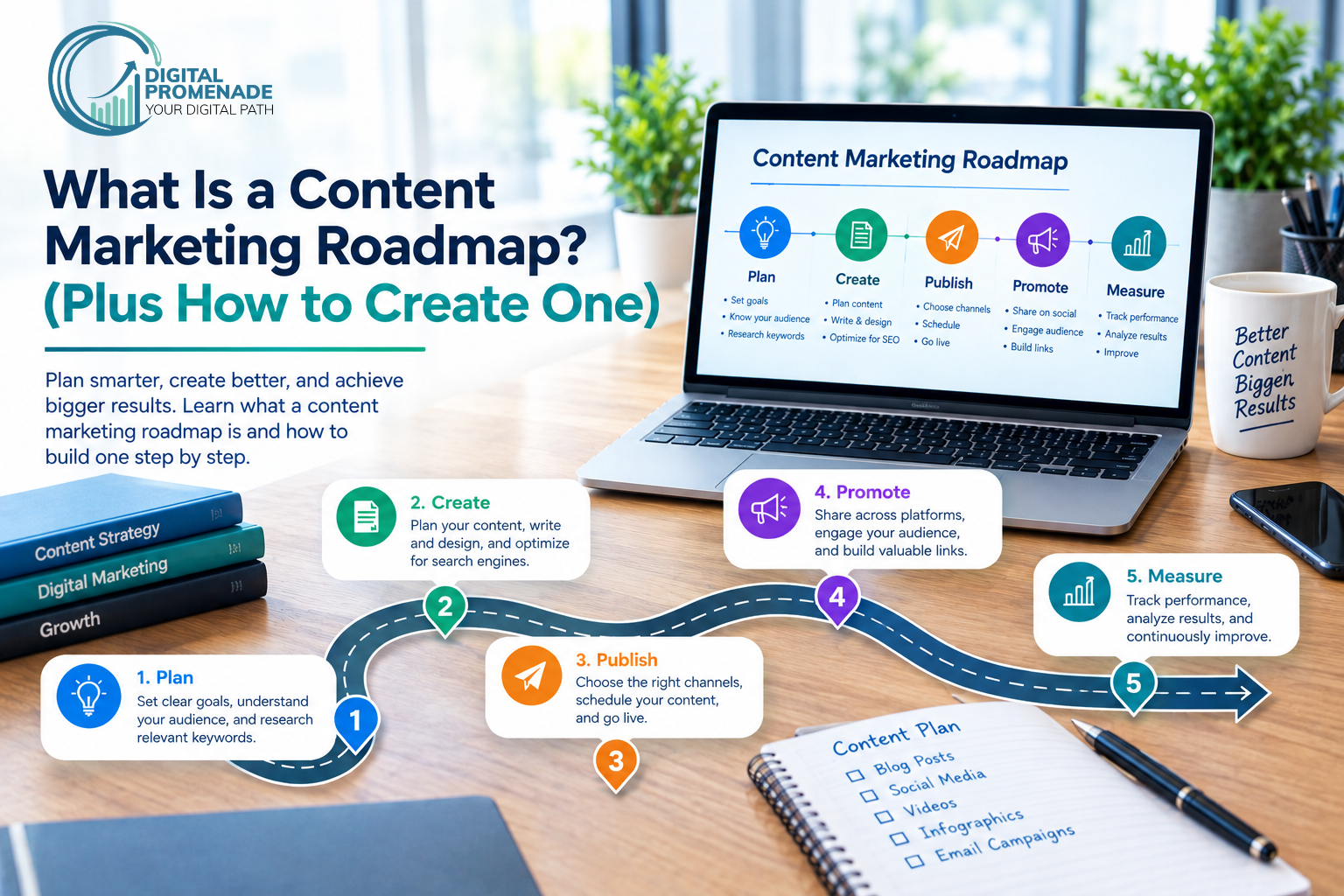
A content roadmap is a quarter-by-quarter plan that ties every piece of content to a business goal, an audience, an owner, and a deadline. We build it after the content strategy and before the calendar, so your team stops guessing what to publish next.
If you searched “what is a content roadmap,” you probably already have a strategy deck or a messy spreadsheet of ideas and still can’t decide what ships first. We hear this on almost every discovery call at Digital Promenade. Google says planning should start with helpful, people-first content, so that’s where our process starts too. Below is the exact method we use when creating a content strategy for a client, minus the jargon.
What is a content roadmap?
A content roadmap is a time-bound plan that lists what content you will create, update, or retire, in what order, and which business outcome each item supports. Most teams plan it by quarter. It sits between your content marketing strategy (the why) and your content calendar (the exact dates).
Think of a road trip. The strategy picks the city you’re driving to. The roadmap picks the stops. The calendar tells you what time to leave each morning. Aha! describes the same idea as a visual plan built around content goals and initiatives.
Quick answer: A content roadmap is a quarterly plan that maps topics, formats, owners, and goals to business outcomes. It links strategy to the calendar.
How is a content roadmap different from a content strategy and a content calendar?
They answer different questions, and a team needs all three.
| Content strategy | Content roadmap | Content calendar | |
| Question it answers | Why and for whom? | What, and in what order? | Exactly when? |
| Timeframe | 1 to 3 years | 1 to 4 quarters | Weeks to a month |
| Detail | Vision, audience, positioning | Themes, topics, formats, owners | Titles, dates, channels |
| Usually owned by | Marketing head | Content manager | Writers and editors |
| How often it changes | Rarely | Every quarter | Weekly |
Most teams skip the middle column. The calendar then fills with whatever is quick to write, and six months later nobody can say why those posts exist. The roadmap fixes that because it forces a ranking before anyone picks a date.
Quick answer: The strategy sets direction, the roadmap sequences the work by quarter, and the calendar schedules single posts. The roadmap is the layer most teams miss.
Why does your content marketing plan need a roadmap?
A content marketing plan without a roadmap is a list of tasks. With one, it becomes a ranked list tied to outcomes. Content Marketing Institute research has repeatedly linked documented strategy with higher self-reported success, and the roadmap is the document that makes that strategy usable day to day.
In our experience the biggest win is saying no. When a founder asks for a post on a trending topic, the roadmap lets us check it against the quarter’s goal in about a minute. It also helps search performance. Planned clusters publish in order, so each new page strengthens the last, which is how good search engine optimization compounds over time.
Quick answer: A roadmap aligns your team, protects focus, assigns ownership, and gives your content marketing plan a measurable target.
What should a content strategy roadmap include?
Seven things. Leave one out and the plan gets wobbly.
- A goal with one primary KPI, such as organic demo requests.
- Your audience and what they search, grouped by intent: learn, compare, or buy.
- Content pillars (broad themes you want to own) and the cluster pages that support them.
- A format and channel for each topic: guide, case study, video, landing page, email, or social.
- Quarterly milestones. Exact dates belong in the calendar.
- One named owner per item, plus budget and tools.
- A review rhythm: monthly check, quarterly reset.
Quick answer: A content strategy roadmap lists goals, audience intent, pillars, formats and channels, milestones, owners, and a review schedule.
How do you create a content roadmap, step by step?
This is the sequence we follow with clients.
Step 1: set one goal and one primary metric
Write the goal in a single sentence, for example: “Raise organic demo requests by 25% in two quarters.” Pick one metric to judge it. Teams that track six metrics usually end up arguing about which one matters.
Step 2: audit what you already have
Export your URLs and sort them by clicks, impressions, and conversions. Mark each page as keep, update, merge, or remove. We usually find that refreshing a handful of weak pages moves the needle faster than writing the same number of new ones. [Insert your own figure here, e.g. “In our last 10 audits, X% of quick wins came from updates.”]
Step 3: research your audience’s questions
Pull queries from Google Search Console, sales calls, support tickets, and “People also ask” boxes. Group them by intent. Sales calls are the most underused source. One recorded call often gives you five better topics than any keyword tool.
Step 4: map topics to the buyer’s journey
Awareness
Definitions, explainers, and checklists answer “what is” questions.
Consideration
Comparisons, templates, and case studies answer “which option” questions.
Decision
Service pages, pricing explainers, and proof answer “should I hire them” questions.
Step 5: score every topic before you commit
We use a simple Priority Score. Rate each factor from 1 to 5.
Priority Score = (Demand + Business value + Win probability) ÷ Effort
| Topic | Demand | Business value | Win probability | Effort | Score |
| Content roadmap template | 4 | 3 | 4 | 2 | 5.5 |
| Content audit checklist | 3 | 4 | 4 | 2 | 5.5 |
| Content strategy for SaaS | 3 | 5 | 2 | 4 | 2.5 |
The highest scores go into quarter one. The numbers above are an example, so rate your own topics with your own data.
Step 6: choose formats and channels
Match each topic to the format that fits its intent. Offers and sign-ups need a purpose-built page, so plan your landing pages and website development early instead of bolting them on after launch. Plan promotion at the same time. Content that nobody shares rarely earns links, so we line up social media marketing and email before the post goes live.
Step 7: assign owners and place items in quarters
Give each item one owner and one quarter. Add buffer for review and design. Keep dates loose until the calendar stage.
Step 8: review monthly, reset quarterly
Compare results with the metric from Step 1. Double down on formats that work, rewrite pages that slip, and cut ideas that no longer fit.
Quick answer: To create a content roadmap, set one goal, audit existing pages, research audience questions, map the buyer journey, score topics, pick formats and channels, assign owners, and review on a schedule.
What does a content roadmap template look like?
Copy this into Google Sheets or Excel and add one row per content item.
| Quarter | Pillar | Topic | Intent | Format | Funnel stage | Owner | Primary KPI | Status |
| Q1 | Content planning | What is a content roadmap | Learn | Guide | Awareness | Content lead | Organic clicks | Draft |
| Q1 | Content planning | Content calendar template | Compare | Template page | Consideration | Strategist | Downloads | Planned |
| Q2 | AI search | Content roadmap for AI Overviews | Learn | Guide | Awareness | SEO lead | Impressions | Planned |
| Q2 | Services | Content strategy services | Buy | Service page | Decision | Account manager | Leads | Planned |
Then match the KPI column to your goal.
| Goal | Primary KPI | Supporting metrics |
| Visibility | Impressions in Search Console | Average position, branded searches |
| Traffic | Organic clicks | CTR, engaged sessions |
| Leads | Form submissions | Assisted conversions |
| Authority | Referring domains | Brand mentions in AI answers |
Quick answer: A content roadmap template needs columns for quarter, pillar, topic, intent, format, funnel stage, owner, KPI, and status, plus a KPI table matched to your goal.
How do you build a content roadmap for AI search and AI Overviews?
Plan for rankings and citations together. Google explains how AI features connect to your site, and the advice is familiar: publish accurate, well-organized, helpful pages.
Here is what we add to every roadmap now:
- Topic clusters, so AI systems see complete coverage of a subject instead of one lonely post.
- A direct answer in the first one or two sentences under each heading, followed by the explanation. Our guide to AI-ready content shows how.
- Tables and numbered steps, which are easy to lift into an answer.
- A watch on how Google AI Overviews affect click-through, so we can rewrite titles and snippets where clicks drop.
- Regular checks on whether your brand appears when people ask assistants. Our process to rank in ChatGPT and Gemini covers this.
- Scheduled updates for pages that gain impressions but lose clicks.
If you’d rather hand this layer to a team, our AI SEO services cover it.
Quick answer: An AI-ready roadmap uses topic clusters, answer-first writing, tables, visibility tracking, and regular updates so pages can rank and get cited.
Which tools work best for a content roadmap?
Start cheap. Most teams don’t need software for the first two quarters.
| Tool type | Best for | Strength | Limit |
| Spreadsheet | Solo marketers, small teams | Free and flexible | Weak collaboration |
| Kanban board | Weekly production | Shows task status | Poor long-range view |
| Timeline view | Quarterly planning | Shows milestones | Needs regular upkeep |
| Roadmap software | Larger teams | Dependencies and reporting | Cost and learning curve |
We’d move to a board or timeline once more than three or four people touch the plan.
Quick answer: Spreadsheets fit small teams, Kanban boards fit weekly production, timelines fit quarterly planning, and roadmap software fits larger teams.
What mistakes break a content roadmap?
We see five again and again.
- No primary metric. Nobody can say if the plan worked.
- Only new content on the plan. Old pages with traffic potential get ignored.
- No promotion plan. A unified paid ads and SEO strategy can give a new page its first push while organic rankings build.
- Shared ownership. When two people own a task, neither ships it.
- A roadmap that never changes. Search behavior and business goals move, so revisit the plan every quarter.
Quick answer: Roadmaps usually fail because of missing KPIs, ignored updates, no promotion, unclear owners, and plans nobody revises.
How we used a content roadmap for a client
Client type and goal: RentoMojo, a furniture and appliance rental brand. We focused on its Noida city page, rentomojo.com/noida. The goal was to grow visibility for local rental searches in Noida, in both classic Google results and AI-generated answers.
What we did: We built a roadmap around the Noida page instead of publishing one-off posts. We audited the page against the questions Noida renters ask, grouped related queries into clusters, and sequenced the supporting content by priority score. [Confirm and replace with your real numbers: audited X pages, built Y clusters, refreshed Z pages, published N new pages.]
Timeframe: [e.g., 6 months]
Results: As of October 8, 2026, Semrush shows the following for the Noida page.
| Metric | Result |
| Organic traffic | 5.2K (+6.4%) |
| Organic keywords | 369 (+8.5%) |
| Authority Score | 49 (rated “Very good”) |
| Referring domains | 169 |
| Backlinks | 283 |
| AI Visibility score | 54 |
| AI mentions | 693 |
| AI-cited pages | about 1K |
The page also shows up across AI search surfaces, not only in organic results.
| AI surface | Mentions | Cited pages |
| Google AI Overview | 314 | 466 |
| Gemini | 159 | 216 |
| Google AI Mode | 120 | 541 |
| ChatGPT | 100 | 180 |
Roughly 45% of the 693 AI mentions come from Google AI Overviews, so we weighted the roadmap toward answer-first formatting.
Ready to build your roadmap?
A roadmap works when it’s short enough to read and strict enough to say no. Set one goal, audit what you have, score your topics, plan for AI answers, and review every month. If you want a team to build it with you, start with our content marketing strategy service, or talk to our team and we’ll review your current content first.
FAQs about content roadmaps
A content roadmap is a quarterly plan showing which content you'll create, who owns it, and which business goal it supports. A dental clinic chasing implant consultations might schedule a cost guide in Q1, a patient FAQ page in Q2, and a before-and-after case study in Q3, each with one owner and one KPI.
A roadmap sets priorities by quarter, and a calendar sets publishing dates. The roadmap says "publish three comparison guides this quarter." The calendar says which one goes live next Tuesday.
Plan two to four quarters ahead and detail only the next one. A small online store can sketch seasonal themes for the whole year but finalize topics for the next 90 days only.
Three to five suits most small and mid-size businesses. A local law firm might pick family law, property disputes, and business contracts, then build clusters under each. Beyond five, effort spreads too thin.
Review it monthly and reset it quarterly. If a page starts earning impressions but few clicks, move a title and snippet rewrite to the top of the next sprint.
Yes, because small teams have the least time to waste. A two-person SaaS startup can run a one-page roadmap with one goal, three pillars, and ten ranked topics.
Track the single KPI you set in Step 1, then check supporting metrics monthly. If the goal is leads, watch form submissions first and treat clicks and impressions as early signals.
It plans clusters, direct answers, tables, and updates, which are the traits that help a page get cited. A service business could plan one pillar page and six question-led articles, then check each month whether AI answers mention the brand.