
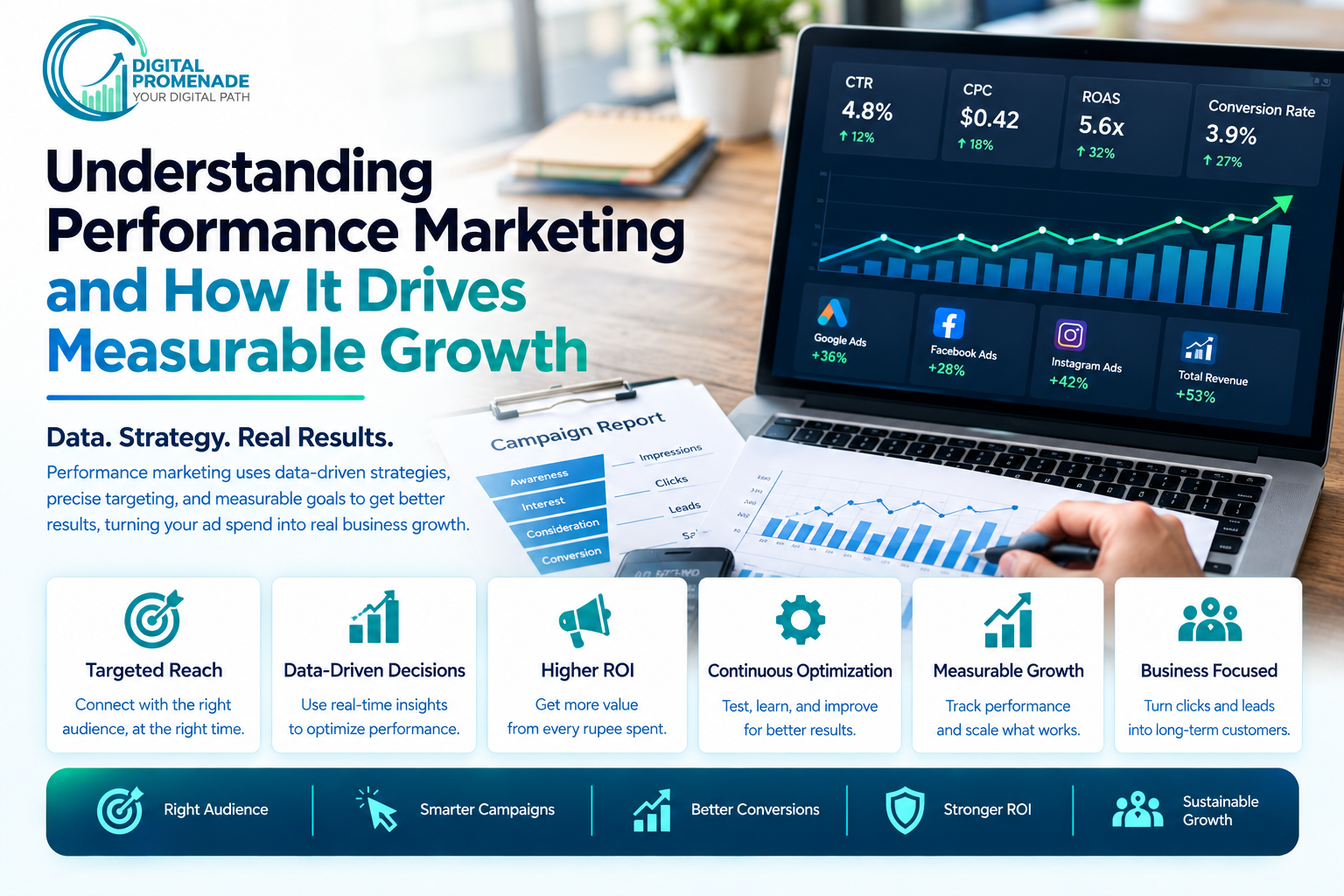
Understanding Performance Marketing and How It Drives Measurable Growth
Performance marketing means you pay for measurable outcomes, such as leads, sales, or app installs, instead of paying for exposure. At Digital Promenade, we use it to tie every rupee of ad spend to a result you can verify, then we optimize each campaign until the numbers justify scaling.
Most business owners ask us the same three questions. Is performance marketing just Google Ads? Does it replace SEO? How do I know my ad spend actually works? This guide answers all three. You will learn how performance marketing works, which metrics matter, which channels fit which goals, and how we build a campaign step by step.
What Is Performance Marketing?
Performance marketing is a form of digital advertising where you pay only when a defined action happens, such as a click, a form fill, a sale, or an app install. You choose the outcome, the channel tracks it, and you judge the campaign by cost per result instead of reach.
How Does Performance Marketing Differ From Traditional Advertising?
Traditional advertising charges for space or airtime: a hoarding, a newspaper insert, a TV slot. You pay first and estimate the impact later. Performance marketing reverses that order. You define the result first, track it from the first click, and adjust spend based on what the data shows.
Adobe’s guide to performance marketing places affiliate marketing under the broader performance umbrella. We build client accounts the same way: several channels, one shared measurement system.
Which Pricing Models Does Performance Marketing Use?
| Model | You pay for | Best for | Example |
| CPC (cost per click) | Each click on your ad | Website traffic, search campaigns | A Google Search ad for “CA firm in Noida” |
| CPL (cost per lead) | Each qualified enquiry | Services, education, B2B | A coaching institute’s admission form |
| CPA (cost per action) | Each completed action | Sign-ups, purchases, bookings | A free-trial registration |
| CPS (cost per sale) | Each sale, often as a commission | Affiliate and e-commerce | A creator earns a percentage of each order |
| CPM (cost per 1,000 impressions) | Visibility | Remarketing, awareness support | A retargeting banner to past visitors |
CPM sits at the edge of performance marketing because it charges for impressions, not outcomes. We use it mainly to support remarketing, and we still judge it by the conversions it assists.
Quick summary: Performance marketing is advertising where you pay for a defined result, such as a click, lead, sale, or install. It differs from traditional advertising because you set the outcome first and measure cost per result. The main pricing models are CPC, CPL, CPA, CPS, and CPM.
How Does Performance Marketing Work?
Performance marketing runs as a loop: set a goal, track it, place ads, then optimize with the data. Each pass through the loop lowers your cost per result.
What Are the Four Parts of a Performance Marketing Campaign?
1. A measurable goal
We start with one business outcome, such as 200 qualified leads a month at a set cost, or a 4:1 return on ad spend. A vague goal like “more visibility” cannot guide optimization.
2. Conversion tracking
We tag every action that matters: form submissions, calls, purchases, and bookings. Without tracking, the platform cannot learn which clicks produce results.
3. Channels and auctions
We place ads where your buyers already search, scroll, and compare. Each platform runs an auction that rewards relevance and expected performance.
4. The optimization loop
We review search terms, audiences, creatives, and landing pages every week. We cut waste, expand what converts, and test one change at a time so we know what caused the result.
What Role Does Attribution Play?
Attribution decides which touchpoint earns credit for a conversion. Last-click attribution credits the final ad a customer clicked. Data-driven attribution spreads credit across the steps that led to the sale. We compare both views, because a campaign that looks weak on last-click often starts the journey that another channel finishes.
Google states that Smart Bidding strategies need conversion tracking before they can work. Read the Smart Bidding overview in Google Ads Help for the official requirements.
Quick summary: Performance marketing works through a four-part loop: a measurable goal, conversion tracking, channel placement, and continuous optimization. Attribution assigns credit to the touchpoints behind each conversion, and accurate conversion tracking is the foundation for every automated bidding strategy.
Which Performance Marketing Metrics Should You Track?
Track the metrics that connect ad spend to revenue: ROAS, CPA, CAC, conversion rate, and lifetime value. Clicks and impressions help diagnose problems, but they do not prove growth.
What Are the Core Performance Marketing Metrics?
| Metric | Formula | What it tells you |
| ROAS (return on ad spend) | Revenue ÷ ad spend | Revenue earned per rupee of ads |
| CPA (cost per acquisition) | Ad spend ÷ conversions | What each result costs |
| CAC (customer acquisition cost) | Total sales and marketing cost ÷ new customers | The full cost of winning a customer |
| CTR (click-through rate) | Clicks ÷ impressions | How well your ad earns attention |
| Conversion rate | Conversions ÷ clicks | How well your landing page closes |
| LTV (lifetime value) | Average revenue per customer over their relationship | How much you can afford to spend on acquisition |
How Do You Calculate ROAS?
Divide the revenue an ad campaign generates by what you spent on it. Google Ads gives a clear example: if every ₹1 of ad spend returns ₹5 in sales, your ROAS is 5:1, which Google expresses as a 500% target ROAS. Google’s Target ROAS documentation explains how the platform uses that number to set bids.
What Is a Good ROAS?
A good ROAS is any figure above your break-even point. Factors.ai reports that a 4:1 ROAS is a common B2C benchmark, while B2B SaaS companies often target 3:1 to 10:1 on pipeline. Treat those numbers as reference points, not goals. Your own margin sets the real target.
How Do You Find Your Break-Even ROAS?
Divide 1 by your gross margin. If your gross margin is 40%, your break-even ROAS is 1 ÷ 0.40 = 2.5. At a 4:1 ROAS, a ₹1 ad spend returns ₹4 in revenue. Forty percent of that is ₹1.60 in gross profit, so you keep ₹0.60 after paying for the ad. At a 2:1 ROAS, you lose money on every sale even though the dashboard shows a healthy return.
Quick summary: The metrics that matter are ROAS (revenue ÷ ad spend), CPA, CAC, conversion rate, and LTV. A good ROAS is one above your break-even point, which equals 1 divided by your gross margin. Industry benchmarks such as 4:1 for B2C guide planning, but your margin decides the target.
Which Performance Marketing Channels Deliver Results?
The right channel depends on where your buyer sits in the decision process. We match channels to funnel stages instead of spreading budget evenly.
How Does Paid Search Perform?
Paid search captures people who already want what you sell. Someone typing “dental implant cost in Ghaziabad” has strong intent, so conversion rates run higher than on most other channels. We build search campaigns around buyer-intent keywords and block irrelevant queries with negative keywords.
How Do Paid Social Campaigns Perform?
Paid social creates demand and reaches people before they search. Our paid social campaigns use audience targeting, creative testing, and conversion-based optimization on platforms such as Meta and LinkedIn. Social works best for visual products, local services, and offers that need a story.
Why Does Remarketing Matter?
Most visitors leave without converting. Remarketing shows relevant ads to people who viewed a product, started a form, or abandoned a cart. It usually delivers a lower CPA than cold prospecting, because the audience already knows you.
Does Affiliate Marketing Count as Performance Marketing?
Yes. Affiliate partners earn a commission only after a sale or lead, so your cost stays tied to results. We recommend it for e-commerce and subscription brands with healthy margins and a strong product page.
Do Email and WhatsApp Follow-Ups Belong Here?
They do, when you measure them by conversions. Follow-up sequences turn leads from paid campaigns into customers, and they raise the return on every click you already paid for.
| Channel | Funnel stage | Typical pricing model |
| Paid search | Decision | CPC, CPA |
| Paid social | Awareness to consideration | CPC, CPL |
| Remarketing | Consideration to decision | CPC, CPM |
| Affiliate | Decision | CPS, CPA |
| Email and WhatsApp | Retention and conversion | Cost per send, measured by CPA |
Quick summary: The main performance marketing channels are paid search, paid social, remarketing, affiliate marketing, and email or WhatsApp follow-ups. Paid search captures existing demand, paid social creates it, and remarketing recovers visitors who left. Match each channel to a funnel stage before you assign budget.
How Is Performance Marketing Different From Digital Marketing and Brand Marketing?
Digital marketing is the umbrella for every online activity, including SEO, content, social, email, and ads. Performance marketing is the part of that umbrella where you pay for tracked outcomes. Brand marketing builds recognition and trust over a longer period, and it rarely produces clean attribution.
| Factor | Performance marketing | Digital marketing | Brand marketing |
| Main goal | Leads, sales, installs | Visibility, engagement, growth | Recognition and trust |
| Payment model | Pay per result | Mixed, paid and organic | Pay for exposure |
| Timeline | Days to weeks | Weeks to months | Months to years |
| Key metrics | CPA, ROAS, CAC | Traffic, rankings, engagement | Recall, share of search |
| Main limit | Stops when spend stops | Slower to show results | Hard to attribute |
Why Do You Need Both Performance and Brand Work?
Performance campaigns harvest demand, and brand work creates it. A business that only runs ads watches its costs climb every quarter, because it never builds an audience that searches for it by name. A business that only builds brand struggles to prove returns. We connect both sides through a unified paid ads and SEO strategy, so paid campaigns fund growth today while organic assets lower your acquisition cost over time.
Quick summary: Performance marketing is a subset of digital marketing where you pay for tracked results. Brand marketing builds long-term trust and is harder to attribute. The strongest strategies combine both: performance campaigns deliver fast, measurable returns, and brand and organic work lower costs over time.
How Do You Build a Performance Marketing Campaign Step by Step?
Follow seven steps: set the goal, fix tracking, pick channels, build the landing page, choose a bidding strategy, test, and report. We use this exact sequence on new accounts.
Step 1: What Business Goal Should the Campaign Serve?
Pick one outcome and attach a number. Example: “Generate 150 qualified leads a month at a cost per lead under ₹800.” Work backward from your margin and sales close rate to set the target.
Step 2: How Do You Set Up Conversion Tracking?
Install Google Tag Manager, connect GA4, and define each conversion: form submit, call click, purchase, booking. Assign values to conversions where you can. Test every tag before you spend a rupee, because a broken tag trains the algorithm on bad data.
Step 3: Which Channels Should You Start With?
Start with the one closest to the sale. Service businesses usually begin with paid search, e-commerce brands with search and shopping plus remarketing, and visual or local brands with paid social. Add channels once the first one hits its target.
Step 4: How Do You Build a Landing Page That Converts?
Ad clicks are wasted without a page that closes. We build conversion-focused landing pages with one clear offer, fast load times, mobile-first layouts, and a short form. Match the page headline to the ad promise.
Step 5: Which Bidding Strategy Should You Choose?
Use Target CPA when you want steady lead costs, and use Target ROAS or Maximize conversion value when revenue matters more than volume. Google requires at least 15 conversions in the last 30 days before you apply a target ROAS to Search and Shopping campaigns, so check your volume first. Start with Maximize conversions if you lack that history. Google’s Target ROAS page lists the current requirements.
Step 6: How Do You Test and Scale?
Change one variable at a time: a headline, an audience, a bid target, or an offer. Give each test enough conversions to mean something. Raise the budget by small steps on campaigns that beat the target, and pause what misses it.
Step 7: What Should Your Reporting Include?
Report spend, conversions, CPA or ROAS, and the business result behind them, such as booked appointments or closed sales. Review weekly for adjustments and monthly for strategy.
Quick summary: To build a performance marketing campaign, set one measurable goal, fix conversion tracking, start with the channel closest to the sale, build a focused landing page, choose a bidding strategy that fits your conversion volume, test one variable at a time, and report on business results. Google requires at least 15 conversions in 30 days for target ROAS on Search and Shopping.
How Is AI Changing Performance Marketing and Search Visibility?
AI now sets most bids, and it also changes how people find answers. We see two shifts: automation inside ad platforms, and AI answers that sit between the searcher and your website.
How Does Smart Bidding Change Day-to-Day Work?
Google classifies Target CPA, Target ROAS, Maximize conversions, and Maximize conversion value as Smart Bidding strategies. The algorithm adjusts bids in each auction using signals such as device, location, and time of day. That shifts your job from manual bid changes to data quality: clean conversion tracking, accurate conversion values, and strong creative.
How Do AI Overviews Affect Clicks and Ad Performance?
AI answers resolve some queries on the results page, so fewer people click through. We covered this in detail in our guide on how AI Overviews are reducing clicks. For performance marketers, the lesson is simple: track assisted conversions and branded search growth, not only last-click sales, and keep your paid and organic strategies connected.
How Do You Get Cited in ChatGPT, Perplexity, and Gemini?
Answer engines pull from pages that state a clear definition, support it with data, and structure information in tables and steps. Strong AI search visibility also needs consistent brand information across the web. Paid campaigns prove demand quickly, and well-structured content earns the citations that keep your brand present when users ask AI tools for recommendations.
Quick summary: AI affects performance marketing in two ways. Smart Bidding automates bid decisions, which makes clean conversion data the main lever you control. AI Overviews and answer engines reduce some clicks, so brands should measure assisted conversions and structure content with definitions, tables, and steps to earn AI citations.
What Results Can You Expect From Performance Marketing?
Expect measurable signals within weeks and a stable, profitable cost per result within a few optimization cycles. The exact timing depends on your sales cycle, conversion volume, and offer.
How Long Does Performance Marketing Take to Work?
Factors.ai states that e-commerce, SaaS, and lead-generation brands that need provable ROI typically look for it within 30 to 90 days. We plan accounts in the same window: the first weeks go to tracking and learning, the middle weeks go to testing, and later weeks go to scaling what works.
What Does Performance Marketing Look Like for Clinics and Doctors?
Clinics measure success in booked appointments, so we count booking calls and form submissions as the main conversions and optimize toward cost per booking. Our guide to Google Ads for doctors walks through the strategy, budget planning, and booking focus we use for healthcare accounts.
Quick summary: Most brands judge performance marketing over 30 to 90 days. Expect early signals in the first weeks and a stable cost per result after several optimization cycles. We measure every client account by cost per result, ROAS, and the business outcome, such as booked appointments or closed sales.
What Mistakes Waste Performance Marketing Budgets?
Three mistakes cause most wasted spend: broken tracking, optimizing for the wrong outcome, and running paid campaigns in isolation.
How Do Tracking Gaps Drain Your Budget?
A missing or duplicated conversion tag feeds the algorithm false signals. It then spends more on clicks that look like wins but bring no revenue. We audit tags before launch and again every quarter.
Why Is Optimizing for Clicks a Costly Mistake?
Cheap clicks do not equal cheap customers. A campaign with a low cost per click and a poor landing page can cost more per sale than a pricier campaign with strong intent. Optimize toward conversions and revenue.
What Happens When You Ignore Organic and Content?
Paid traffic stops when your budget stops. Strong SEO services build traffic that keeps compounding, and content that supports paid campaigns answers buyer questions before they click an ad. Together they lower your blended cost per acquisition.
Quick summary: The costliest performance marketing mistakes are broken conversion tracking, optimizing for clicks instead of revenue, and running paid ads without organic and content support. Audit tracking regularly, optimize toward conversions, and connect paid and organic work to lower your blended acquisition cost.
How Do You Choose a Performance Marketing Agency?
Choose an agency that shows you the numbers, gives you account ownership, and ties its work to your profit. Check these five points before you sign:
- Account ownership: You own the ad accounts, pixels, and data from day one.
- Transparent reporting: You see spend, conversions, and revenue in a live dashboard, not a monthly PDF alone.
- Profit-based targets: The agency sets goals using your margin, not vanity metrics.
- Proof of results: The agency shares real client numbers with context, such as timeframe and starting point.
- Testing process: The agency explains how it tests, learns, and decides what to scale.
Quick summary: A good performance marketing agency gives you account ownership, transparent reporting, profit-based targets, verifiable client results, and a clear testing process.
Performance Marketing FAQs
Performance marketing is advertising where you pay for results, such as clicks, leads, or sales, instead of paying for impressions. Say a Noida coaching institute runs a Google Search ad. It pays when a student clicks, and it tracks how many clicks turn into admission enquiries. The institute then raises the budget on keywords that bring enrolments and cuts the ones that do not.
No. PPC is one tactic inside performance marketing. Performance marketing also covers affiliate programs, cost-per-lead deals, conversion-optimized paid social, and the tracking system behind all of them. A PPC campaign becomes performance marketing when you measure it by conversions and optimize toward them.
Yes. Affiliate marketing falls under the performance marketing umbrella because you pay partners only after a defined action. A skincare brand that pays creators a 10% commission on each tracked sale is running performance marketing. It owes nothing until an order arrives.
A good ROAS is any figure above your break-even ROAS, which equals 1 divided by your gross margin. A store with a 40% margin breaks even at 2.5:1. A 4:1 return, a common B2C benchmark, then leaves ₹0.60 in profit for every ₹1 spent on ads before overheads.
You need enough budget to generate conversion data. Google asks for at least 15 conversions in 30 days before you apply a target ROAS to Search and Shopping campaigns. If your expected cost per conversion is ₹500, you need roughly ₹7,500 a month to reach that threshold. That figure marks a minimum for learning, and it does not replace a growth budget.
Most brands look for provable returns within 30 to 90 days. A clinic running Google Ads often sees enquiries within the first few weeks. Reaching a profitable cost per booking takes several rounds of keyword, ad, and landing page tests.
Yes, as long as you measure the right outcome. A B2B software company should track qualified demo requests and pipeline value, not raw form fills. A form fill from a student researching a topic and a demo request from a buyer with budget carry very different value.
Performance marketing is part of digital marketing, so the real question is balance. A store that relies only on paid ads loses traffic the moment it pauses spend. Adding SEO and content builds assets that keep working, and paid campaigns keep revenue flowing while those assets grow.
What Should You Do Next?
Start with three actions. Define one outcome and its target cost. Audit your conversion tracking. Calculate your break-even ROAS. Those steps alone expose most of the waste in a typical account.
If you want a second set of eyes on your numbers, book a free strategy consultation with our team. We will review your tracking, your targets, and your channel mix, and we will show you where the next gain sits.