
Mastering Search Engine Optimization: Essential Tutorials for Digital Marketers
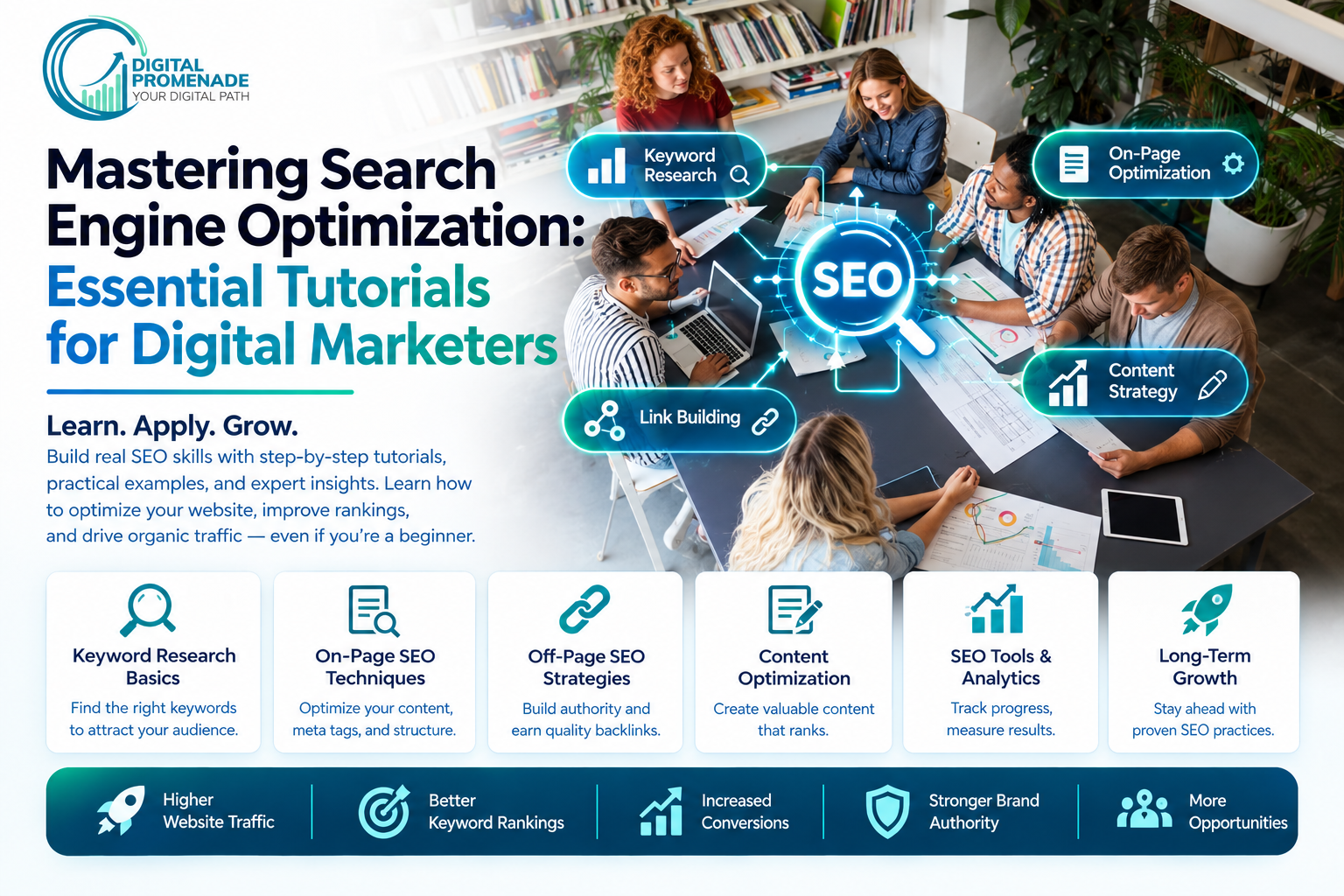
This search engine optimization tutorial follows the exact order we use at Digital Promenade when a site starts from zero: understand how search engines work, choose keywords people actually buy with, fix the page and the code, earn trust off your site, then measure what happens. SEO works when you do five jobs in sequence: make your site crawlable, match search intent, prove your authority, answer questions in a format AI can quote, and track revenue instead of rankings. Skip one and the others stall.
Most beginners hit the same wall. You read ten guides, get ten different checklists, and still can’t decide what to do on Monday morning. We wrote this search engine optimization tutorial for beginners and working marketers to end that confusion. Each section answers one question, gives you the steps, and closes with a short summary you can copy into your notes.
The stakes are higher than they were a few years ago. Ahrefs reports that 96.55% of pages get no organic traffic from Google, and the same roundup links AI Overviews to a 58% lower click-through rate for the top-ranking page. Knowing the basics is not enough anymore. You need them in the right order.
What Is SEO and Why Does It Still Matter in 2026?
SEO, short for search engine optimization, is the practice of improving a website so search engines can find it, understand it, and show it to people searching for what you offer. If you have ever typed “what is SEO” into Google, that is the short answer. The longer answer is that SEO earns you visitors without paying for each click.
What Are the Three Branches of SEO?
Every task you will ever do falls into one of three branches. We use this split to assign work and to diagnose why a page is not ranking.
| Branch | What it covers | Example tasks | First question we ask |
| On-page SEO | Everything visible on the page | Titles, headings, copy, internal links, images | Does this page answer the query better than page one does? |
| Off-page SEO | Signals from outside your site | Backlinks, brand mentions, reviews | Who vouches for us, and how credible are they? |
| Technical SEO | How your site is built and served | Crawlability, speed, mobile, structured data | Can Google reach and render every page that matters? |
Does SEO Still Work When AI Answers Questions?
Yes, and we see it in client accounts every week. Google states plainly that it does not accept payment to crawl a site more often or rank it higher, so organic rankings remain the one position nobody can buy. AI Overviews have taken clicks, though. Pew Research Center’s 2025 browsing study found people clicked a traditional result on 8% of visits when an AI summary appeared, compared with 15% when it did not. Fewer clicks mean every click you earn has to come from a page that deserves it, and your brand has to appear inside the AI answer too. We cover both below.
Skim summary: SEO is the work of making a site findable, understandable, and trusted by search engines. It has three branches (on-page, off-page, technical), it remains the only unpaid way to earn search visibility, and AI answers raise the standard instead of replacing it.
How Do Search Engines Work?
Search engines work in three stages: crawling, indexing, and serving results. Google describes the same three stages in its own documentation, and every ranking problem we diagnose traces back to one of them.
What Is Crawling?
Crawling is discovery. Googlebot downloads pages by following links and reading the sitemaps you submit. Pages blocked in robots.txt or hidden behind a login never enter the process. A clean XML sitemap tells Googlebot which URLs you care about.
What Is Indexing?
Indexing is analysis and storage. Google renders the page, reads the text, images, and metadata, checks whether another page duplicates it, and picks a canonical version. Google confirms that indexing is never guaranteed, so a crawled page can still stay out of search results. That is the moment many beginners panic. Don’t. It usually means the page is thin, duplicated, or blocked by a stray noindex tag.
How Does Google Serve and Rank Results?
When someone searches, Google selects indexed pages that match the query and orders them using signals such as relevance, quality, location, language, and device. No single score exists for you to game.
| Stage | What happens | Common blocker | How we fix it |
| Crawling | Googlebot discovers and downloads URLs | robots.txt rules, orphan pages, server errors | Allow key paths, add internal links, fix 5xx errors |
| Indexing | Google renders and stores the page | noindex tags, duplicates, thin content | Remove accidental noindex, set canonicals, add depth |
| Serving | Google ranks pages for a query | Weak intent match, low authority | Rewrite for intent, earn links |
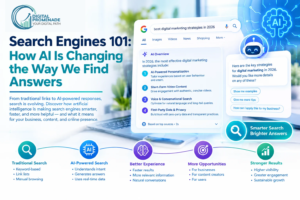
How Do AI Search Tools Change the Process?
ChatGPT, Perplexity, and Google’s AI features retrieve pages and quote them in generated answers, so being crawlable and indexable is now the entry ticket to being cited. We explain how those features reshape clicks in our breakdown of Google AI Overviews and their CTR impact.
Skim summary: How search engines work comes down to crawl, index, serve. Blocked or duplicated pages fail before ranking even starts, so check discovery and indexing first, then work on relevance and authority.
How Do You Find Keywords That Bring Customers?
Start with the phrases your customers already use, group them by intent, and pick the ones you can realistically win. This is the part of SEO for beginners that decides everything after it, because a perfectly optimized page aimed at the wrong keyword earns nothing.
Step 1: Collect Seed Topics From Real Conversations
Ask your sales and support teams what prospects ask before they buy, and write down the exact words. Customers often say “cheap” while the business writes “cost-effective,” and that gap hides a lot of traffic.
Step 2: Expand With Free Tools
Use Google autocomplete, the People Also Ask box, Keyword Planner, and the query report inside Google Search Console.
Long-Tail Keywords
Longer phrases such as “seo tutorial for beginners” carry clearer intent and less competition than “SEO.” New sites win here first.
Question Keywords
Queries that start with who, what, how, and why feed featured snippets and AI answers, so we build a section for each one.
Step 3: Match Each Keyword to an Intent
| Intent | Example query | Page we build |
| Informational | what is seo | Definition or guide page |
| Learning | seo tutorial for beginners | Step-by-step tutorial |
| Commercial | best seo company for startups | Comparison or service page |
| Transactional | hire seo consultant | Service page with a clear call to action |
| Local | seo agency near me | Local landing page |
Step 4: Score and Choose
We score each keyword from 1 to 5 on relevance, intent match, competition we can beat, and business value. Anything scoring 16 or higher out of 20 goes first. The model is simple on purpose, and it stops teams from chasing high-volume terms they cannot win.
Step 5: Map One Primary Keyword to One Page
Two pages chasing the same keyword compete with each other. Assign one primary keyword per page, then plan supporting pages around it. Our guide to building a content roadmap shows how we turn a keyword list into a publishing plan.
Skim summary: Good keyword research means collecting customer language, expanding it with free tools, classifying intent, scoring each term on four factors, and giving every keyword exactly one page.
What Is On-Page SEO and How Do You Optimize a Page Step by Step?
On-page SEO is everything you change on a page, from copy and tags to links and images, so search engines and readers understand what the page offers. This seo tutorial for beginners section works as a seo step by step guide you can repeat for every page.
How Do You Write a Title Tag and Meta Description?
Put the primary keyword near the start of the title and keep it around 50 to 60 characters so it does not truncate. Write the meta description in about 155 characters as if it were ad copy. Google sometimes rewrites both, but a strong draft still wins more often than a missing one.
How Should You Structure Headings?
Use one H1, then H2s for the main questions and H3s for steps. Put a direct answer in the first sentence under each heading. Featured snippets and AI answers lift those sentences.
How Deep Should the Content Be?
Deep enough to finish the reader’s task. Google’s helpful content guidance asks who created the page, how, and why, so we add first-hand evidence, named authors, and original examples. Our SEO content writing service builds every page on that standard.
[ADD CLIENT RESULT: e.g., “When we rebuilt [client name]’s five main service pages around question-led headings, organic clicks rose [X%] in [timeframe].”]
How Do Internal Links, URLs, and Images Help?
Use descriptive anchor text, short readable URLs, and compressed images with accurate alt text. We aim for three to five contextual internal links per 1,000 words.
Do You Need Schema Markup?
Structured data from Schema.org helps search engines read entities such as Article, Organization, Product, and LocalBusiness. Google limits FAQ rich results to a narrow set of sites, so treat FAQ markup as a clarity aid, not a traffic promise.
| Element | Target | Mistake we see most |
| Title tag | 50 to 60 characters, keyword early | Keyword stuffing |
| Meta description | About 155 characters, one clear benefit | Duplicate descriptions across pages |
| H1 | Exactly one per page | Missing or multiple H1s |
| Image alt text | Describes the image plainly | Empty or stuffed alt text |
| Internal links | Descriptive anchors | “Click here” anchors |
Skim summary: On-page SEO covers titles, meta descriptions, heading structure, content depth, internal links, images, and schema. Answer the query in the first line under each heading, then add evidence that proves you know the subject.
What Is Technical SEO and Which Fixes Come First?
Technical SEO makes sure search engines can crawl, render, and index your site quickly. Fix problems in this order: crawl and index blockers, speed, mobile experience, then structure.
Crawl and Index Health
Robots.txt and Noindex Tags
A single stray line can hide a whole site. We have seen sites launch with the staging noindex tag still live, and nothing ranked until someone found it.
Canonical Tags and Duplicates
Set one canonical URL per page so parameter and print versions do not split your signals.
XML Sitemap
List only indexable, 200-status URLs, and submit the file in Search Console.
Speed and Core Web Vitals
Google measures experience through Core Web Vitals. Aim for Largest Contentful Paint at 2.5 seconds or less, Interaction to Next Paint at 200 milliseconds or less, and Cumulative Layout Shift at 0.1 or less.
Mobile-First Design and HTTPS
Google indexes the mobile version of your page, so test that version first. Serve every page over HTTPS.
Site Architecture
Keep every important page within three clicks of the homepage. If your template fights you, our website development services rebuild the structure with SEO requirements built in.
| Fix | Impact | Effort | Our order |
| Remove accidental noindex and robots blocks | Very high | Low | 1 |
| Fix server errors and redirect chains | High | Medium | 2 |
| Improve LCP and INP | High | Medium to high | 3 |
| Set canonicals and merge duplicates | Medium | Low | 4 |
| Add structured data | Medium | Low to medium | 5 |
The order above is our judgment from audit work, so adjust it when your site has a different bottleneck.
Skim summary: Technical SEO starts with whatever stops Google from reaching or indexing pages, then moves to speed, mobile usability, and site structure. Core Web Vitals targets are 2.5 seconds for LCP, 200 milliseconds for INP, and 0.1 for CLS.
How Does Off-Page SEO Work Beyond Backlinks?
Off-page SEO builds outside evidence that people trust you, through links, mentions, and reviews. Search engines and AI systems both read that evidence.
Why Do Backlinks Still Matter?
A link from a relevant, respected site tells search engines that someone staked their reputation on your page. Ten relevant links beat a hundred directory links. Before chasing any link, we ask whether it could send real visitors.
How Do Brand Mentions and Digital PR Help?
Original data, expert quotes, and useful tools earn mentions without begging. Journalists and bloggers cite what saves them time.
How Do Reviews and Reputation Fit In?
What customers say about you appears in search results and in AI answers. Our case for online reputation management explains why we treat it as part of off-page SEO.
What Do We Avoid?
We avoid paid link schemes, private blog networks, and comment spam. They break Google’s spam policies, and the penalty costs far more than the shortcut saves.
Skim summary: Off-page SEO means earning backlinks, brand mentions, and reviews from credible sources. Relevance beats volume, and manipulative link tactics carry real ranking risk.
How Do You Optimize for Google AI Overviews, ChatGPT, and Perplexity?
Write answer-first pages, name your entities clearly, and keep content fresh. Ahrefs data shows AI-cited content runs about 25.7% fresher than pages ranking in Google’s organic results, so recency is a real signal here.
Our view is plain: AI optimization is SEO fundamentals applied to new surfaces. The crawl, index, and quality chain stays the same. This seo optimization tutorial section is the one we update most often, and our AI SEO services cover it end to end.
What Steps Make a Page Easy for AI to Cite?
- Put a direct 40 to 60 word answer under every question heading.
- Use your brand, author, and product names consistently, and add Organization schema.
- Allow AI crawlers in robots.txt unless you have a deliberate reason to block them.
- Publish original data, since AI answers favor sources that add something new.
- Review key pages every quarter and update the date only when the content changes.
- Test your brand monthly by asking each AI tool the questions your customers ask.
| Surface | What it rewards | What we optimize |
| Google AI Overviews | Pages that rank and answer directly | Answer-first structure, strong E-E-A-T signals |
| ChatGPT search | Crawlable, authoritative pages | Open crawler access, brand mentions |
| Perplexity | Recent, well-cited sources | Fresh updates, original data, clear sourcing |
Skim summary: To earn AI citations, answer questions directly, keep entities consistent, allow crawler access, publish original data, and refresh content on a schedule. It is the same SEO work, aimed at answer engines.
How Do SEO, Paid Ads, and Local Search Work Together?
Paid search buys speed, SEO builds assets that keep paying, and local search captures nearby buyers. We run them as one system.
How Do SEO and PPC Support Each Other?
This seo marketing tutorial point saves clients real money: paid search-term reports show which queries convert, and we then build organic pages for those exact terms. We explain the full model in why every brand needs a unified paid ads and SEO strategy.
What Does Local SEO Involve?
Claim and complete your Google Business Profile, keep your name, address, and phone number identical everywhere, collect genuine reviews, and build location pages with real local detail. Our local SEO services follow that exact checklist.
Skim summary: Use paid ads for fast data, SEO for compounding returns, and local SEO for nearby intent. Feed paid keyword data into organic content plans.
How Do You Measure SEO Progress and Know It Is Working?
Track impressions and clicks in Search Console first, then rankings for mapped keywords, then leads and revenue in your analytics tool. Rankings alone mislead, because a page can rank well and still earn no business.
| Metric | Where to find it | What good looks like |
| Impressions | Search Console | Rising for target pages first |
| Clicks and CTR | Search Console | Clicks grow after title and snippet updates |
| Indexed pages | Search Console Pages report | Key pages indexed, no surprise exclusions |
| Keyword positions | Rank tracker or Search Console | Movement toward page one for mapped keywords |
| Conversions | Analytics | Organic leads and revenue growing |
| AI mentions | Manual prompts or tracking tools | Brand named in answers |
How Long Does SEO Take?
Impressions usually move first, clicks follow, and leads arrive last. That pattern frustrates people, and we understand why. You are paying for work whose payoff shows up in stages. We lay out realistic timelines in our guide on how long SEO takes to wor k, so you can judge progress by the right milestone at the right time.
[ADD CLIENT RESULT: e.g., “For [client name], impressions rose [X%] by month [N], and organic leads followed by month [M].”]
Skim summary: Measure impressions, clicks, indexed pages, rankings, conversions, and AI mentions. Expect impressions to rise before clicks, and clicks before leads.
Which SEO Mistakes Do Beginners Make Most Often?
Beginners mostly fail by skipping steps, not by missing advanced tricks.
Targeting Keywords With the Wrong Intent
A product page will not rank for a “what is” query. Match the page type to the intent first.
Publishing Thin Pages to Hit a Schedule
Four useful pages beat twenty filler pages. Google’s helpful content guidance says as much.
Ignoring Technical Blockers
A leftover noindex tag, a blocked folder, or a slow template can cancel months of writing.
Chasing Links Before Content
Nobody links to a weak page. Build the page worth citing first.
Judging Results After Three Weeks
Search engines need time to crawl, index, and test your pages. Set a review date at least a quarter out.
Skim summary: The five most common beginner mistakes are wrong intent, thin content, technical blockers, link chasing before content, and judging results too early.
Your SEO Step by Step Guide: A 30-Day Action Plan
This plan turns everything above into a month of work you can start today.
| Week | Focus | What you finish |
| 1 | Foundation | Set up Search Console and analytics, run a crawl, fix indexing blockers |
| 2 | Keywords | List 50 keywords, score them, map the best 10 to pages |
| 3 | On-page | Optimize your top 5 pages, add internal links, fix titles and meta descriptions |
| 4 | Authority and tracking | Choose 3 outreach targets, request reviews, build a simple dashboard |
Skim summary: In 30 days you can fix blockers, map keywords, optimize five pages, begin link and review work, and set up tracking.
Frequently Asked Questions About SEO Tutorials
SEO is making your website easy for search engines to find and worth ranking, so customers reach you without you paying per click. Picture a dentist who writes a clear page on root canal costs in her city and keeps her Google Business Profile accurate. When a patient searches, her clinic appears because the page answers the question and Google trusts the listing.
In our experience, you can learn the fundamentals in four to six weeks of steady practice, but skill comes from applying them for a year or more. A marketer who follows the 30-day plan above will understand crawling, keywords, on-page work, and measurement by the end of the month. The judgment about what to fix first arrives after a few real projects
Yes, because Google Search Central, Search Console, and Keyword Planner cost nothing. A boutique owner can read Google’s documentation, connect Search Console, and improve ten product pages in a month without buying a tool. Paid tools save time later, but they are not a starting requirement.
Yes, because AI tools retrieve and cite the same pages that search engines crawl and trust. Clicks have fallen on queries that show AI summaries, so the aim shifts to earning both the ranking and the citation. A brand with clear answers, consistent entities, and strong reviews gains in both places.
SEO earns organic visibility, while SEM usually means buying visibility through paid search ads. A plumber who needs calls tomorrow can run ads today, then build service pages that bring calls for free over the following months. Together they cover both the short and the long game.
No, they mean the same thing, and the difference is only spelling. Readers in India and the UK often type search engine optimisation tutorial, while American readers type search engine optimization tutorial. Search engines treat both as the same topic, so one well-built page can serve both audiences.
You do not need to code to start, but basic HTML and an understanding of how your CMS works will save you hours. A marketer can check indexing in Search Console and read a robots.txt file without writing code. Fixing render-blocking scripts or redirect rules usually needs a developer, so learn the vocabulary and brief them clearly.
Review key pages every three to six months, and sooner when rankings or clicks slip. A service page whose pricing or process changed last quarter should change on the page too. Fresh, accurate content earns trust from readers and from AI systems that prefer recent sources.
Conclusion
SEO rewards the people who work in order: crawlable site, matched intent, strong pages, earned trust, AI-ready answers, honest measurement. We built this search engine optimization tutorial so you can follow that order without guessing. Start with the 30-day plan, fix blockers before you write anything new, and check your numbers every month.
If you would rather have a team run it with you, we at Digital Promenade offer a free strategy consultation where we review your site and give you a clear roadmap. Bring your questions, and we will bring our checklist.